

White permanent vinyl is the workhorse of everything I sell on a Saturday morning. Names on tumblers. A jersey number on a shirt for my granddaughter's volleyball team. The address numbers beside my own front door. I have cut a lot of it and I have thrown a fair amount of it in the bin under my folding table. The roll I keep reordering is Frisco Craft glossy white permanent vinyl, the 12 inch by 30 foot size, and after two years of working through it I can tell you exactly where it helps you and exactly where it will not.
Most vinyl reviews are written on day one, when the decal is still pristine and nothing has been through a dishwasher or a wet winter. This one is written from the other end. I have a tumbler that came back with a curled rim, a shirt that has been through more washes than I can count, and a mailbox number that has survived two Columbus winters. Some of what follows is the vinyl's fault. Some of it is mine. I will try to keep those two things separate, because that is the only kind of review worth reading.
The Quick Verdict
A dependable glossy white that cuts and weeds cleanly once you learn its two quirks. It is not the most forgiving film on a tight curve, and it will not cover for a rushed application.
Amazon Check Today's Price →If you already know you want thirty feet of white, this is the roll I keep buying.
Twelve inches wide, glossy white, permanent adhesive, rated fade resistant and waterproof for smooth indoor and outdoor surfaces. The listing publishes its Cricut and Silhouette settings, so your first cut is not a guess.
Amazon Check Today's Price on Amazon →What This Roll Actually Is
Twelve inches wide, thirty feet long, and the roll itself measures about 12 by 2.5 by 2.5 inches on the shelf, so it stands upright on a pegboard hook without taking over the wall. The face is glossy white and the backing is a permanent adhesive. The listing rates it fade resistant and waterproof and recommends it for smooth surfaces indoors and outdoors, with plastic named as the surface type it was built around. In practice that means bare plastic, glass, sealed wood, powder coated metal, and any painted surface that is genuinely smooth and genuinely clean.
Buying it as a roll rather than a pack of sheets changes how you work. The roll feeds onto a cutting mat and lets me cut a long piece, a nameplate or a row of labels, in one pass instead of lining up five separate sheets. The trade is that you cannot lay thirty feet flat anywhere, so anything longer than the mat has to be planned in sections. I cut most of my work in twelve inch lengths, clip the rest of the roll closed, and keep it wound so the edge stays clean.
The sentence in the listing that matters most is the one about water. Do not wash the vinyl with water until twenty four hours after it has been applied. That is not a lawyer being careful. The adhesive needs time to bite into the surface, and if you hand a freshly decorated tumbler to a customer who rinses it that same evening, you will hear about it later. I now finish everything the night before the market and let it sit.
The other thing worth knowing up front is that this is a permanent adhesive, not a removable one. There is no second chance on a tumbler. Once it touches down and you burnish it, that is where it lives. If you are the kind of person who likes to lift a corner to check the alignment, this product will punish that habit, and the punishment is a stretched decal you have to throw away and start over.
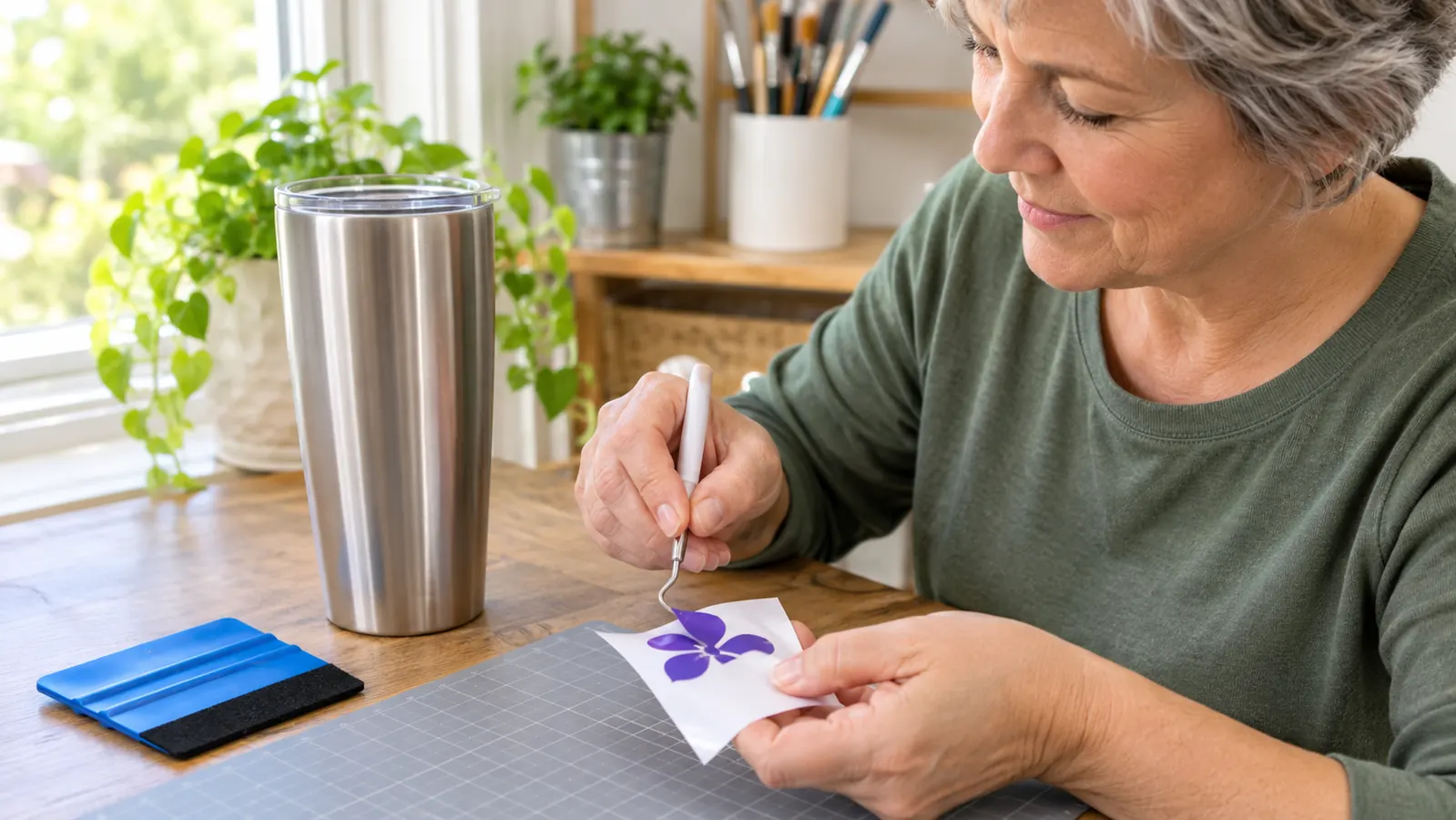
How I Cut It, and the Settings That Actually Worked
The listing publishes starting settings, which is more than most vinyl sellers bother to do. For a Cricut it recommends the standard blade on the iron on setting. For a Silhouette Cameo it gives blade one, speed three, force six, two passes, and smooth as the material setting. I cut on a Cricut, and the iron on setting is the one I have used for two years, because a default vinyl setting does not quite get through this backing. An under cut does not fail on the machine. It fails ten minutes later, when you are weeding and the backing tears up through the middle of a letter.
I keep a dedicated fine point blade for vinyl and change it more often than feels reasonable. A dull blade on glossy white is the difference between lifting a clean shape and dragging a ragged edge across a name you now have to recut. Before any run longer than a few decals, I cut a two inch test square at the corner of the sheet and weed it. If the square lifts the way a sticker should lift off a page, I go. If it fights me, I add pressure or a second pass before I waste a full sheet.
The room matters too. My setup is a converted spare bedroom with a long folding table and a pegboard wall, and in July that room is humid enough that the film gets clingy and the backing curls at the cut edges. In January it is dry and the roll behaves perfectly. When the humidity is up I let the cut sheet rest flat for a minute before I start weeding, and that small pause saves me a lot of torn detail work.
Storage is the part nobody warns you about with a roll this long. I keep mine wound tight with a strip of painter's tape across the tail so the edge does not unspool and pick up dust from the pegboard. A dusty edge is a decal with a line of grit welded underneath it, and no amount of burnishing fixes that. If your workroom is a spare bedroom like mine, keep the roll off the floor and out of the window sun, and it will behave the same on the last foot as it did on the first.
Weeding, Transfer Tape, and the Trouble With a Gloss Finish
Weeding is where a vinyl roll earns its keep or does not. Frisco Craft weeds cleanly if the cut was right. Small counters in a script name, the dot on an i, the gap inside an e, they come up in one piece as long as the blade was sharp. What I would not do is cut a design with hairline strokes under a sixteenth of an inch and expect it to hold together on the hook. Glossy film has a slicker face than matte, and very thin pieces have a habit of curling onto the hook instead of staying on the backing where you left them.
Transfer tape is the other place people get surprised. The gloss grabs the tape firmly, which is good for lifting a whole word at once and bad when you press the tape down hard and the decal comes up off its own backing before you are ready. I use a medium tack tape, press it once with a squeegee and no more, and lift slowly from a corner. If you are new to permanent vinyl, buy medium tack and not the strong one. Strong tape on a permanent adhesive is how you invent new words in front of your granddaughter.
And the finish itself is honest about your work. A gloss surface shows every fingerprint, every smear, and every scratch from a squeegee that had a grain of grit under it. On a tumbler you will notice this for about a week and then you will stop, and the customer will never notice at all. On a large flat piece for a wall or a sign, wipe it down with a dry cloth before you hand it over, because the gloss will show whatever you left behind.
How It Holds Up Outdoors
My real test has been the house numbers beside my front door and a second set on the mailbox post. Two Columbus winters, two summers, plenty of rain, and one hailstorm that took the finish off my car. The decals are still crisp, still white, and still stuck. No lifting at the edges that I can find and no yellowing I can see from the porch. The fade resistant and waterproof claims have held up in the one place a customer will actually test them, which is outside on a wall in the weather.
I also have a small sign that sat in a west facing window for a full summer, which is the harshest light I have to offer. The white is still white. The only change I can find is a faint sheen difference where the sun hit hardest, and I had to hold it at an angle in the kitchen light to see it at all. For a film that spends its life outdoors by design, that is more than I expected from a roll at this level.
The one outdoor failure I had was my own doing. I applied a set of numbers to a mailbox post that had been painted the week before, and by the end of the month the vinyl had lifted at two corners. Fresh paint gives off vapour for weeks, and the adhesive never got a fair surface to hold. Now I wait at least two weeks after any paint before I apply, or I scuff and clean first, and the lifting stopped. Same roll, same post, different result, and the difference was the surface.
Tumblers are a different story and worth being straight about. A tumbler that goes in the dishwasher gets hot, wet and knocked around, and a permanent decal on a curved powder coated surface is under real stress. I tell customers to hand wash and to use the top rack only if they must, and I wait the full twenty four hours before the first wash no matter how much they want to take it home and use it. The ones that have failed for me failed because I skipped that wait, not because the film was bad.
Shirts are where I would slow down. Permanent vinyl on fabric is a stiff layer on something that wants to stretch, and this film is not a stretch product. On a shirt it is fine for a name or a number that sits flat on the chest or the back. It is the wrong choice for a design that wraps a sleeve or crosses a seam, and it will crack at the fold if a jersey gets pressed into a drawer still warm. For anything that has to move with the fabric, a heat transfer material is the right tool and this roll is not it.

Where It Fights You
The first honest limitation is conformability. This film does not like compound curves. A tapered tumbler with a sharp shoulder, a helmet crown, a mug that bulges before it narrows, those are all places where the vinyl wants to bridge rather than follow. A little heat from a hair dryer helps it settle and I do keep one at the table, but heat also softens the adhesive, and on a permanent vinyl that means a mistake becomes permanent faster. Mark the placement first, then commit.
One habit that saved me on curved work: cut the decal slightly larger than the shape, apply it, then trim on the object with a sharp blade held at a shallow angle. Trimming in place gives you an edge that follows the curve. Cutting to exact size first and then trying to make it follow a curve is how you end up with a gap on one side and an overlap on the other, and neither one is fixable once the adhesive has grabbed.
This is also where the comparison to Oracal 651 comes up, and it is a fair comparison. Oracal has its shop reputation for a reason and it is the more forgiving film on a curve. What I will say is that on flat work, which is most of what I do, the difference did not show up in the finished piece. It showed up in my comfort level while applying it. If you cut a lot of curved drinkware, that comfort is worth paying for. If you cut address numbers, labels and flat signs, Frisco Craft will do the job. I wrote a longer side by side of the two if you want the detail, and a separate piece on what six months of steady use did to a roll.
The second limitation is the tack. Permanent means permanent, and this adhesive grabs early. On a large flat piece I hinge it with tape, work from the center out with a squeegee, and keep the backing between the film and the surface for as long as I can. On a small decal I line it up dry and accept that I get one attempt. If you are used to removable vinyl and the freedom to reposition, the first hour with this roll will feel like a negotiation. After that you learn to measure twice.
What I Liked
- Cuts cleanly with the published settings, iron on for Cricut and the Cameo numbers in the listing
- Weeds well on normal detail when the blade is sharp
- Fade resistant and waterproof claims held for two winters on an outdoor mailbox post
- Thirty feet on a twelve inch roll, enough to get through a market season without reordering
- Gloss face wipes clean and reads well at a distance on signs and numbers
Where It Falls Short
- Permanent adhesive grabs on contact, no repositioning
- Not conformable on compound curves without heat and patience
- Gloss shows fingerprints and squeegee scratches
- Needs a full twenty four hours before any water, which slows a last minute order
- Cracks at folds on fabric, so it is the wrong product for stretchy shirt designs
Two winters on a mailbox post and the numbers are still crisp and still white. That is the whole case for this roll, and it is a strong one.
Who This Is For
This roll suits someone doing flat and gently curved work in volume. Address numbers, mailbox decals, labels for jars and bins, flat signs, tumblers with a straight side, names on a shirt that sits flat. It suits the person with a market table who needs a white that behaves the same way every time, so they can stop thinking about the material and think about the design instead. It also suits a beginner who wants a long roll to practice on, because thirty feet of Frisco Craft is a lot of practice and the film cuts predictably once the settings are right.
Who Should Skip It
Skip it if your work is mostly compound curves, if you cut a lot of drinkware with a shoulder, or if you need to slide a decal around during application. Skip it if your customers will rinse a tumbler the same night they get it, because the twenty four hour wait is not optional and you will be the one answering for it. And skip it if you are decorating stretch fabric with a wrapped design, since a heat transfer material is built for that and this roll is not. None of that makes it a bad product. It makes it the wrong product for those jobs, and it is better to know that before the order is on the table.
Thirty feet, one white, and settings that are already written down.
If flat work and straight sided tumblers are most of your table, this is the roll that stops being a variable. Read the twenty four hour line before your first order goes out the door.
Amazon Check Today's Price on Amazon →