
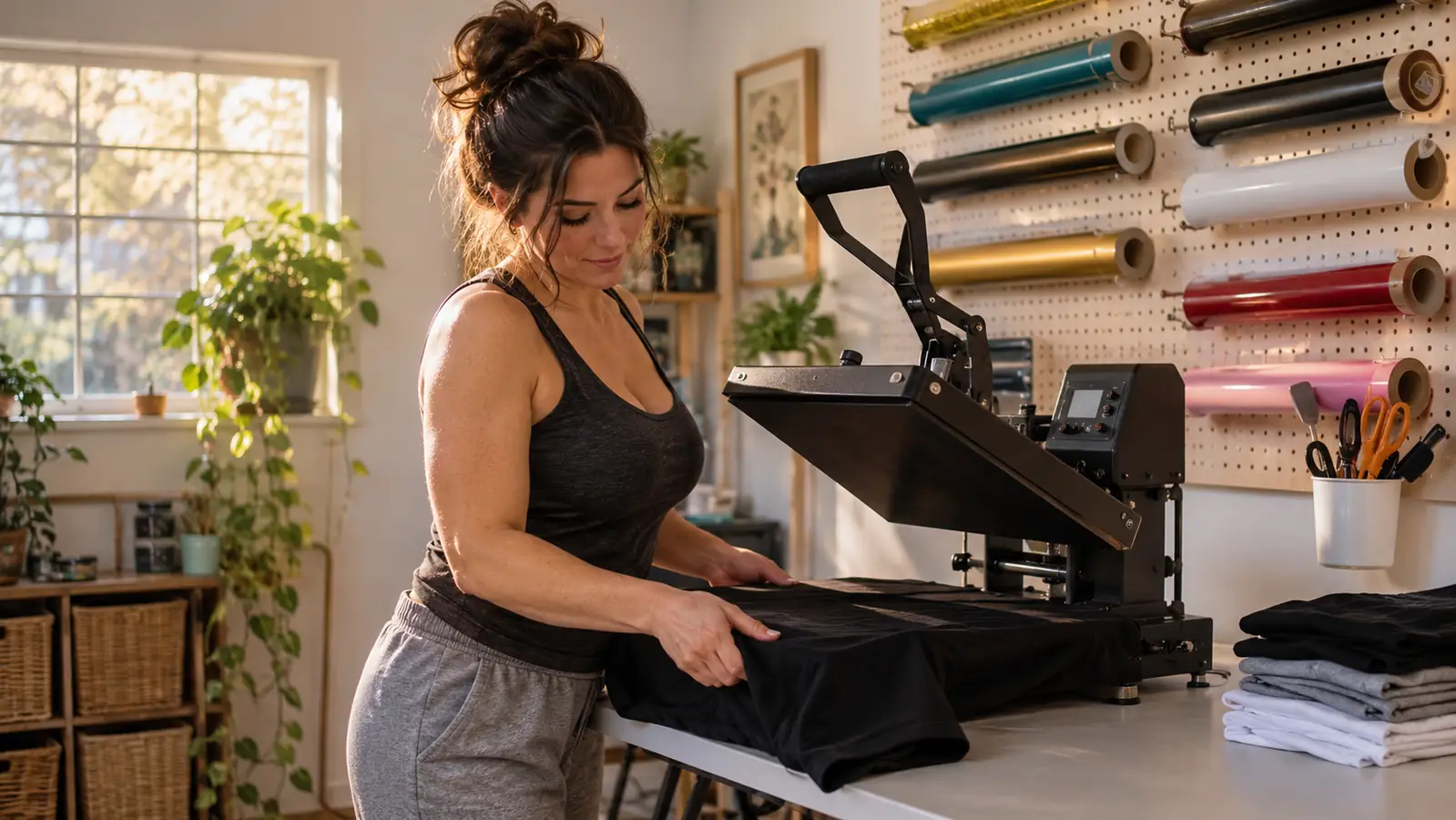
The spare bedroom has one long folding table, a pegboard wall of vinyl rolls, a closet shelf of blanks, and a heat press that takes up more of the table than I planned for. I bought the Fancierstudio 15x15 after a season of pressing shirts with a household iron, a bath towel, and a lot of hope. If you have ever peeled a transfer off a shirt and watched half of it stay stuck to the carrier paper, you already know why I stopped doing it that way.
This is not a review of how much money you can make. I sell at a Saturday craft market a couple of times a month and take orders from church and from Nia's school teams, and that is the whole operation. What follows are the ten reasons this particular machine stayed on my table, in the order they actually mattered to me, plus the one purchase I would skip if I were starting over. Ray does the second pair of hands on busy weekends, and even he can run the Fancierstudio, which tells you something about the controls.
The press that ended my iron-and-towel era
15 by 15 inch platen, digital time and heat control, Teflon-coated platen, 1800 watts. The same machine that has been sitting on my folding table.
Amazon Check Today's Price on Amazon →One pass covers a full adult front
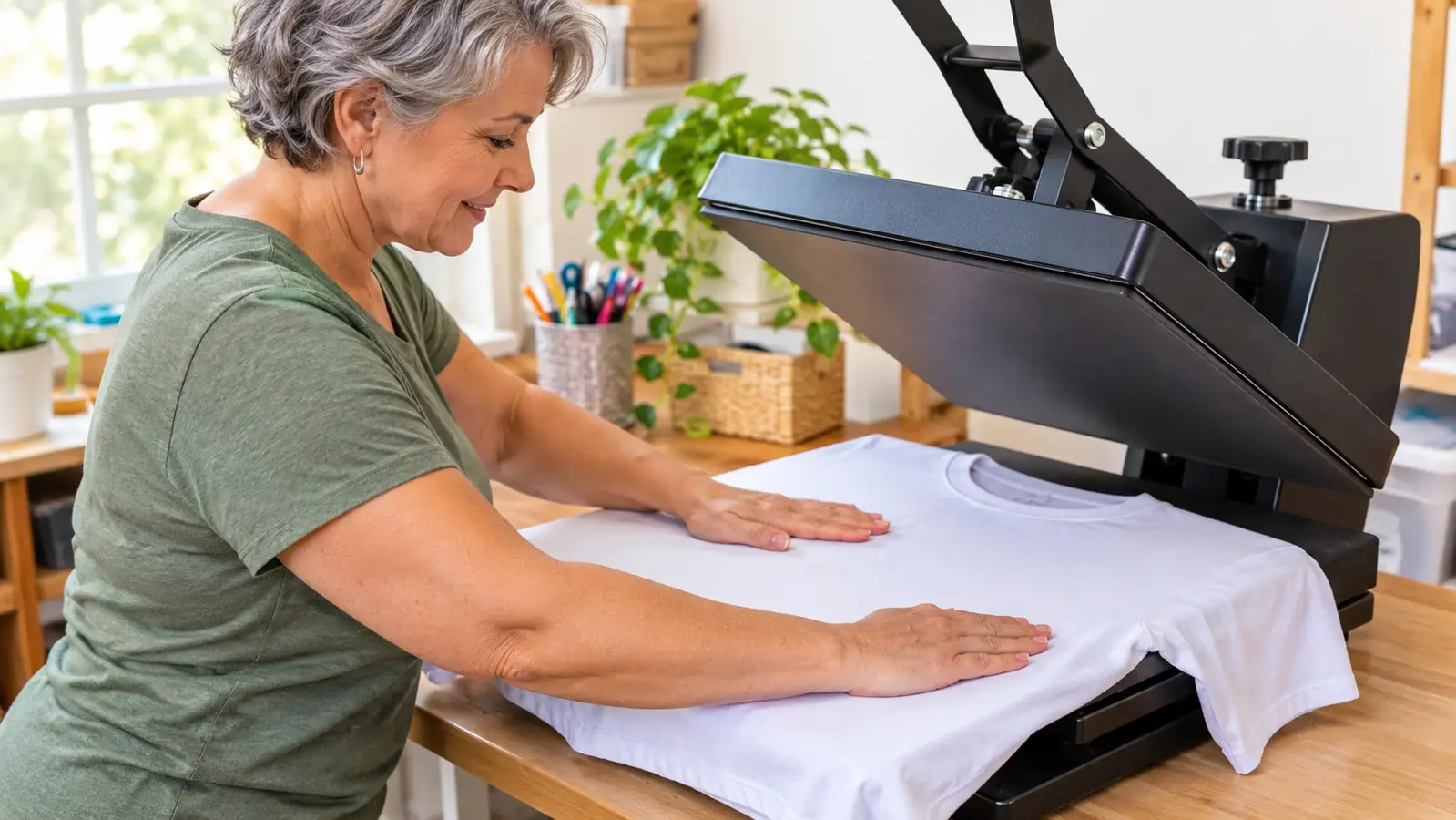
The Fancierstudio platen measures 15 by 15 inches, and that number matters more than it sounds. A standard adult front print sits inside that square with room to spare, so a shirt goes down once and comes off finished. On a smaller press you press the top half, wait, slide the shirt down, press the bottom half, and hope the seam where the two passes meet does not show. Nia's volleyball jerseys have a number across the chest and her name above it. Both fit in a single pass, and one pass is one chance to scorch a collar instead of two.
Temperature to the degree, time to the second
The front panel runs electronic time and heat control, with a temperature range of 0 to 699 degrees F and a time range of 0 to 999 seconds. That is more range than I will ever use, and that is fine. What I care about is the precision. Every vinyl brand wants a different setting, and I keep an index card taped to the wall with mine written down. When a card says 305 degrees for 15 seconds, I can set 305 and 15 and walk away. The machine holds it. Nothing drifts while I am lining up the next shirt.
1800 watts climbs back to heat between shirts
Every time you open a press, the platen loses heat. On a run of twenty team shirts, that adds up fast if the machine is slow to recover, because you stand there with a shirt in your hand watching a number crawl back up. At 1800 watts, this one gets back to temperature quickly enough that I am usually still aligning the transfer. It runs on 110 volts, so it plugs into a normal household outlet. It is also the reason I do not run the iron or the space heater on that same circuit in the spare bedroom. One heavy draw at a time.
The Teflon platen coating saves pressing sheets
The heat platen has a Teflon coating on it. That coating does two quiet jobs. It keeps adhesive residue and stray glitter from baking onto the metal, and it means most transfers press without a separate sheet laid over the top. I still use one for anything with a printed carrier film, because I would rather not find out the hard way. But I stopped buying pressing sheets by the pack, and I stopped scrubbing the platen with a cloth every third shirt, which is a small thing that feels large on a Saturday morning.
It presses flat blanks that are not t-shirts
The listing names bags, mouse pads and t-shirts as recommended uses, and that matches what I actually run. Canvas totes for the market, mouse pads for the church fundraiser, onesies for a baby shower that came together at the last minute. All of it is flat, and flat is what this machine does well. A tote bag with a stiff bottom seam needs a little care to sit level, and I press those with the seam hanging off the edge of the platen. Once you learn that trick, a tote takes the same fifteen seconds a shirt does.
Steady heat for rhinestones and sublimation
The machine is built for rhinestone and sublimation work as well as plain vinyl, and both of those want the same thing: even pressure and heat that does not wander. Rhinestone transfers are unforgiving. A cool corner and half the stones lift on the first wash. Sublimation blanks are the same story in reverse, where uneven heat shows up as a dull patch in the middle of a photo panel. A flat platen that holds its set temperature is most of the battle. I do not do a lot of sublimation, but what I have done on the Fancierstudio came out clean on the first try.
The 15 by 15 pressing sheet comes in the box
A 15 by 15 inch heat press sheet is included with the machine. It is a small inclusion and it is the right one, because it means your first shirt does not sit on the table waiting for a separate order to arrive. I used the included sheet for the first month, then added a couple of my own for the multi-layer jobs. If you are the kind of person who orders the machine and the accessories in one go, know that this one already has the basic sheet covered. Fewer boxes on the porch, fewer days before you can press something.
A footprint that fits a spare-room table
The listed dimensions are 33 inches long, 23 inches wide and 20 inches high. Mine sits against the short wall of the folding table and still leaves room to stack blanks on the left and lay a finished shirt flat on the right. That sounds like a small thing until you have tried to work on a table with no clear space left on it, which is how my first month went. If your setup is a converted bedroom like mine, measure the table before you order, then measure the swing of the arm. It needs room to come up and back down without hitting the pegboard.
A three-month warranty you should read first
The Fancierstudio warranty is three months. I am putting that high on the list on purpose, because it is the honest part of the deal and you should know it before the box arrives. Three months is enough to find out whether you got a good unit, and not much more. Mine has run for a couple of years of weekend work without a problem, and I still check the cord and the platen before every market. Treat the first three months as your shakedown period. Press often, press a range of blanks, and if something is off, say so early rather than in month five.
Thousands of ratings mean the problems are already written down
At the time I looked, the machine carried a 4.6 rating across 9,550 reviews. That is not a guarantee of anything. What it does mean is that almost every way this press can misbehave has already been described by someone, in public, with a photo. When my first transfer lifted at one corner, I found six other people with the same corner and three different fixes. Buying a machine with a thin review base means you are the one writing the troubleshooting thread. I would rather read it than write it.
What I'd Skip
I would skip anything that promises this press will do a job it was not built for. It presses flat. A mug, a cap, a shoe, anything with a curve needs different equipment, and no amount of technique turns a flat platen into a curved one. I would also skip the bundles of vinyl that get bolted onto a press order. You will end up with twelve colors you do not use and one you run out of in a week, and you will not know which is which until you have pressed with them. Buy two rolls of the color you actually need and learn the settings on those. The last thing I would skip is buying a second press before the first one has taught you anything. This machine has more range in it than my skills did in the first year.
One more skip, and it is the one I got wrong. I nearly bought a bigger press because I thought bigger meant more capable. A 15 by 15 platen already covers a full adult front, and the extra size would have eaten the end of my table and half the walking space in the spare bedroom. If most of what you press is shirts, totes and the occasional mouse pad, this is the size. The bigger machine is for people pressing oversized backs and banner panels, and those people already know who they are.
The 15 by 15 platen means Nia's jersey number and her name both go down in one pass, and one pass is one chance to ruin a shirt instead of two.
Four years into cutting vinyl, the thing I care least about is how a machine looks and the thing I care most about is whether it does the same job twice. This one does. The same platen, the same 15 by 15 press, the same setting on the card, shirt after shirt. That is not a dramatic recommendation. It is the recommendation of someone who has a closet shelf of blanks, a Saturday market to show up for, and no interest in re-learning her equipment every season.
If your table is already full, this is the machine that earns its space
15 by 15 inch platen, 0 to 699 degrees F, 0 to 999 seconds, 1800 watts, Teflon-coated platen, 110 volts. Check today's price and the current specs on the listing.
Amazon Check Today's Price on Amazon →