
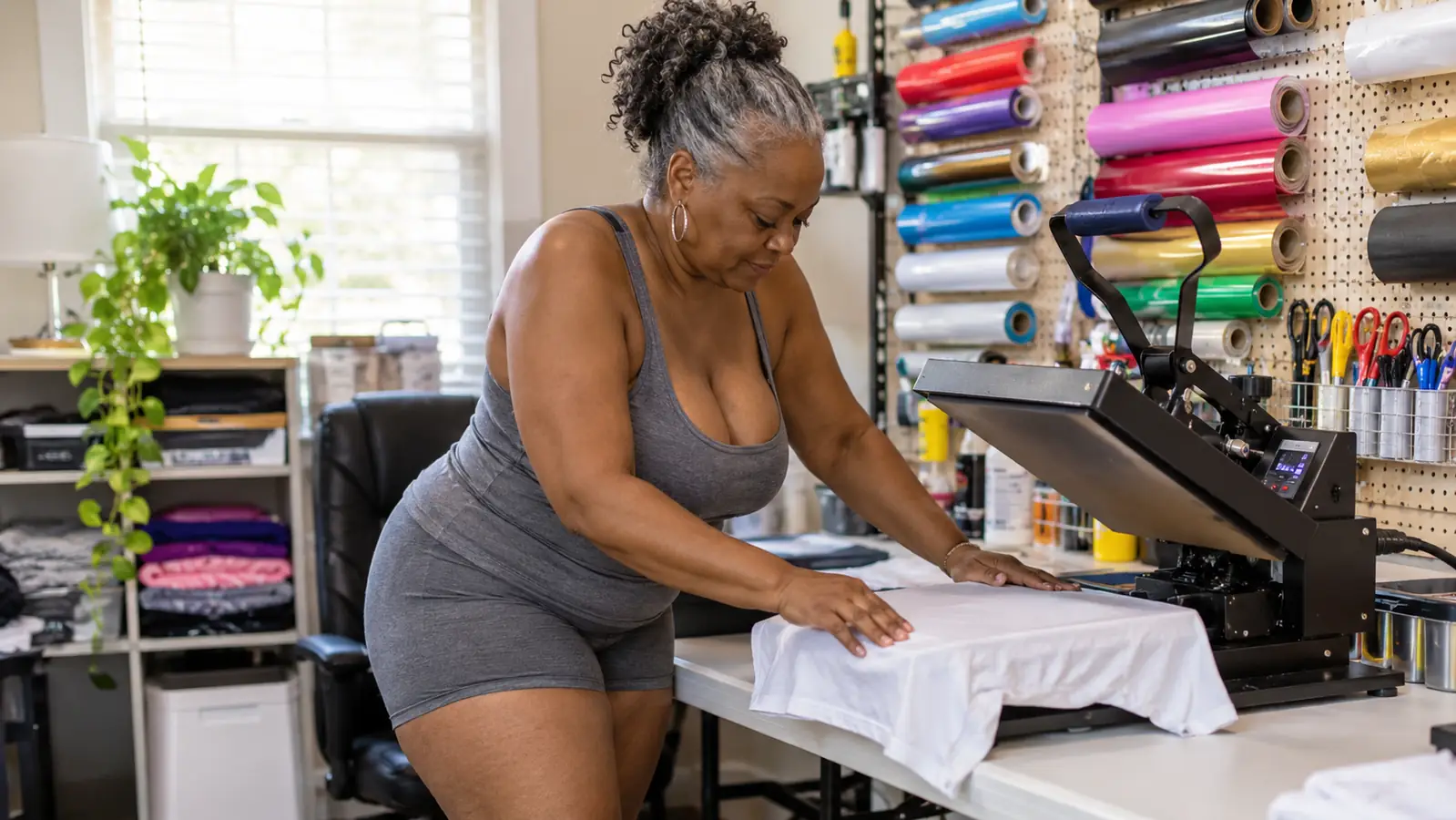
The Fancierstudio 15x15 heat press came in a box that needed both of us to carry it up the stairs. The first thing I did after setting it on the folding table was push a bin of vinyl rolls onto the floor so the machine would fit. The listing gives the footprint as 33 inches long, 23 inches wide, and 20 inches high. I had read that number before I ordered. I had not really believed it. If you are picturing this on the corner of a kitchen counter, picture something else, because it wants a table of its own or a very patient husband.
I run a small decal and shirt table out of my spare bedroom in Columbus. Four years of cutting vinyl, a couple of Saturday markets a month, plus orders from friends, church, and my granddaughter's volleyball team. For most of that time I pressed everything with a household iron and a sheet of parchment, which works right up until the moment it does not. The Fancierstudio is the machine I bought to stop guessing. This is the honest version of how that has gone, including the parts I would rather not put in writing.
What follows is not the listing copied out with the word premium added. It is what an 1800 watt, 110 volt press with a 15 by 15 inch platen actually does in a spare bedroom, on a folding table, when you have eleven shirts due Saturday and the timer is the only thing standing between you and a ruined poly blend.
The Quick Verdict
A capable 15 by 15 press with real heat behind it and a control box that expects you to think. The three month warranty is the part I want you to hear clearly before you order.
Amazon Check Today's Price →Stop pressing shirts with an iron and hoping
1800 watts, a 15 by 15 inch platen, and electronic time and heat control that holds a setting instead of drifting on you. That is the whole argument for this machine in one sentence.
Amazon Check Today's Price on Amazon →How I Actually Use It
Most of what I press is cotton. School shirts, church shirts, team shirts with a number on the front and a name across the back. The listing recommends this press for t-shirts, bags, and mouse pads, and that matches my table almost exactly: cotton shirts, canvas totes, the occasional mouse pad for a market order, and rhinestone templates when someone talks me into them.
A shirt takes about ninety seconds of actual pressing once it is laid out. The laying out is the slow part. The machine is not the bottleneck and never has been. Getting a design straight on a youth small while a nine year old waits is the bottleneck, and no press fixes that.
The part I did not expect was how much this changed the finish. An iron gives you a decal that looks applied. A press at the right temperature gives you a decal that looks manufactured. Customers do not say that looks pressed. They say that looks like a store made it. That is the difference I was after, and it showed up on the very first batch.
What Nobody Tells You About a 15 by 15 Platen
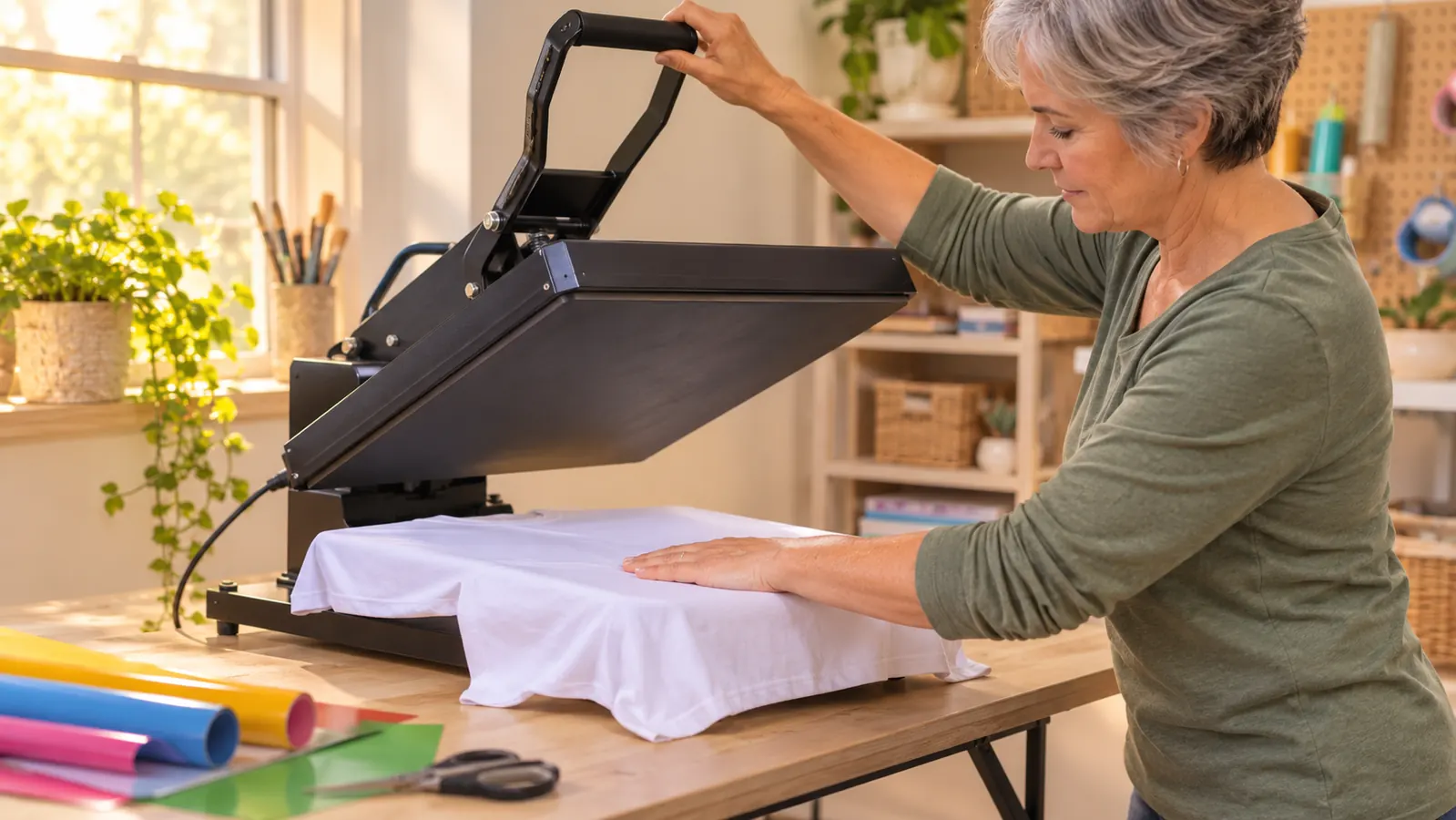
Fifteen inches square is a strange size to think about until you own one. An adult shirt front runs roughly twelve inches across the chest, so a design up to about eleven inches wide fits with room to spare. Full back prints also fit. What does not fit is a design running shoulder to shoulder on a 3XL, and there is no trick for that. You press it, slide it, and press again, and you hope the seam lands somewhere nobody looks.
The platen is Teflon coated. The listing calls that out and I now understand why it matters. Vinyl does not stick to it, and I am not scraping adhesive off a plate at eleven at night with a plastic scraper and a bad attitude. It also means I stopped using a separate protective sheet for most presses, although I still use one for rhinestones, because those stones will find a way.
The other thing about the size is that it is a table hog and it is not a machine you put away. Mine lives out. If your only surface is the dining table you eat dinner on, measure first, then decide whether you want to be lifting this thing twice a day for the rest of the year.
Eleven shirts in a row at 360 degrees and not one lifted at the edge. With my iron, two or three out of every ten would.
The Control Box Expects You to Pay Attention
The controls are electronic. You set a temperature and a time on the panel and it holds them. Time runs from 0 to 999 seconds. The temperature range is listed as 0 to 699 degrees F in the product features, and the upper temperature rating is listed as 500 degrees F in the attributes. Both numbers are in the same product data. I cannot tell you which one is correct, because I press cotton at 360 and poly blend at 305 and I have never gone near either ceiling.
That contradiction is worth saying out loud, because it is the kind of thing you should know before you buy rather than after. It also tells you something about the manual, which is thin. The machine is not complicated, but nobody walks you through it. You will learn your press by ruining things, or you will learn it by reading temperature charts and going slowly. I recommend the second one, and I say that as someone who did the first one.
1800 watts at 110 volts is the other number that matters, and it is not about power. It is about your wall. That is a lot of draw for a bedroom circuit. I do not run mine on the same outlet as the cutter. I do not run it on the same outlet as a space heater, and I would not run an extension cord with anything else plugged into it. If a breaker trips mid press, you get a half applied decal, a bad mood, and a shirt you cannot save.
Pressure Is Where Your First Ten Shirts Go Wrong
Nobody sells you this part. The temperature is on a screen. The time is on a screen. The pressure is something you feel and guess at, and it took me about a dozen shirts before I trusted my own hands. Too little and the vinyl lifts at the edge on the third wash. Too much and you get a shiny, pressed flat look across the design plus a seam line burned into the shirt where you did not want one.
My test is a corner of scrap vinyl on an old towel. I press it for ten seconds, let it cool completely, then peel. If it comes up with a little resistance and leaves a clean edge, I am close. If it peels away like a sticker, I need more pressure or more time. If the towel shows a hard shine line, I have gone too far and I back off before I touch a real shirt.
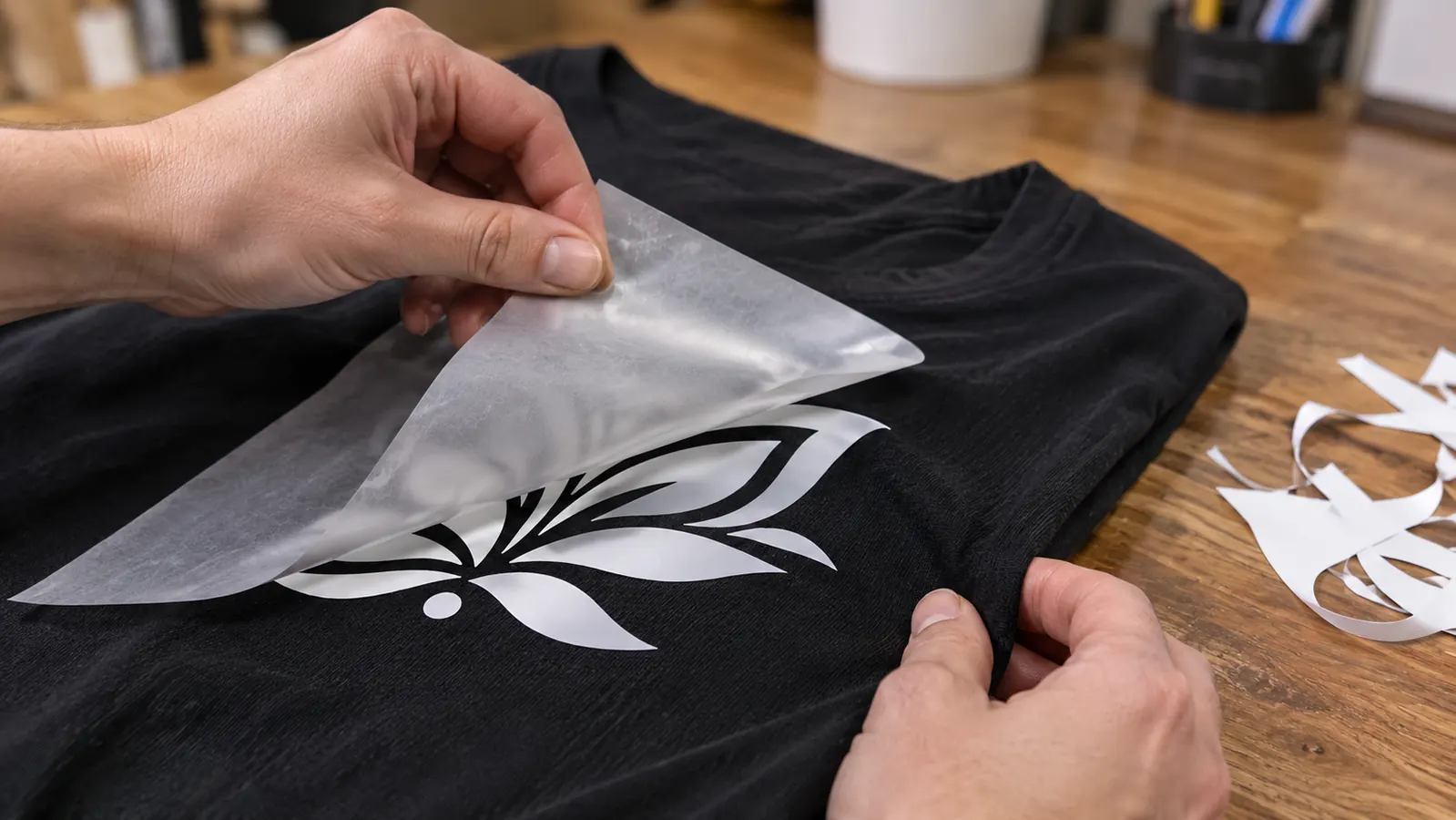
Cool peel versus hot peel matters more than I understood at the start. Most of what I press is a cool peel, and the ten seconds I spend waiting feels like ten wasted seconds right up until you peel one early and watch the edge curl while you are still holding it.
What Went Wrong in My First Month
I scorched a poly blend on day three. I had 360 in my head from cotton and did not think about the fabric at all. The shirt went shiny across the chest and there was no fixing it. That is a press mistake rather than a machine mistake, but it is the mistake this press will let you make at speed, because it heats fast and it does not warn you.
I also had an edge lift on a canvas tote, which was a pressure problem, and a corner of a design that would not take on a shirt with a thick seam running underneath. That second one is about the platen being flat and the shirt not being flat. You learn to press around seams, and to fold a towel under the low side so the surface you are actually pressing is level.
None of that is a defect. All of it is a machine that does exactly what you tell it, which is the honest case for it and against it at the same time. There is no setting anywhere on this press that saves you from a bad layout.
A Note on Heat in a Small Room
The press gets hot and the room gets warm. My spare bedroom has one window and a door I keep open. After an hour of pressing I turn a box fan on low and point it at the wall, not at the machine, because blowing air across the platen while you are waiting for it to recover is a good way to make your temperature wander when you are least expecting it.
This is not a warning label item. It is just what a 15 by 15 platen at 360 degrees does in a space the size of a bedroom over an afternoon. If your workspace is a bedroom with no airflow, plan for it before August, not during.
The Three Month Warranty, and What I Would Want You to Hear
The warranty is three months. That is the number in the product data and I am not going to dress it up or pad it. For a machine that runs this hot it is short, and it is one of the reasons I would buy this with clear eyes rather than in a hurry on a Friday night.
In practice mine has run a long stretch without trouble. The failure I hear about most from other people at markets is a heating element that stops getting hot, not a control panel that dies. Two of those people bought the same class of press a second time rather than deal with a return. I would not do that, but I understand the impulse when you have orders due.
If you buy it, write the date on the box, keep the box for the full three months, and put the machine through real work in the first two weeks. Any problem shows up while you can still do something about it. That is not a press specific tip. It is just what I would tell a friend at the craft table.
What I Would Do Differently
I would buy the press first and the cutter second. I did it the other way around. For a year I was cutting clean designs and then ruining them with an iron, and I spent most of that year convinced my cutting was the problem. It was not. The press was the missing half of the process, and I could have saved myself a lot of second guessing.
I would also keep a notebook from day one. Temperature, time, fabric, how the peel went. I started one after the scorched poly blend and it has saved me more shirts than any single piece of advice I have been given. Twenty seconds with a pen beats an hour of trying to remember what worked on canvas back in March.
What I Liked
- 1800 watts heats quickly and recovers fast between shirts
- The 15 by 15 inch platen handles adult front designs and full back prints
- Electronic time and heat control holds a setting, so your tenth shirt matches your first
- Teflon coated platen keeps adhesive off the plate and saves you the scraping
- Time range of 0 to 999 seconds plus a temperature range that covers cotton, blends, and rhinestones
- A 15 by 15 inch heat press sheet is included, so you can press the day it arrives
Where It Falls Short
- Three month warranty is short for a machine that runs this hot
- The published temperature range and the published upper temperature rating do not agree
- 1800 watts will crowd a bedroom circuit, so you need to plan your outlets
- Footprint of 33 by 23 inches, and it is not a machine you fold away between uses
- Pressure is set by feel, with nothing on the panel to guide you
- The manual is thin and assumes you already know what you are doing
Who This Is For
This press is for someone who has been faking it with an iron and has hit the ceiling of what an iron can do. If you sell shirts at a market, if you make team shirts twice a season, if you already own a cutter and a shelf of vinyl and you are tired of edges that lift after three washes, this is a sensible place to land. The Fancierstudio is not a machine that hides its limits, and that is exactly why it suits a small table like mine. You will know what it can do within a week, and what it cannot do within a month, and both answers are useful.
It also suits anyone pressing bags and mouse pads alongside shirts, since that is what the listing recommends and what my own table looks like. Cotton, canvas, and the odd synthetic blend all behave the way you would expect once you have your numbers written down.
Who Should Skip It
Skip it if you press five shirts a year for your own family and you are happy with how they come out. A press this size is a piece of furniture, and furniture you do not need is just clutter with a cord on it.
Skip it if your only workspace is a shared dining table that has to be clear by six. Skip it if you want a machine that tells you what pressure to use, because this one will not. And skip it if a three month warranty is a dealbreaker for you, because that is the number, and no amount of good reviews changes it. I would rather you read that here than find it in the box.
If you have outgrown the iron, this is the honest next step
1800 watts, a Teflon coated 15 by 15 inch platen, and a control panel that holds the setting you gave it. Read the warranty, measure your table, then go look at today's price.
Amazon Check Today's Price on Amazon →